Claude Code (2025): A Comprehensive Analysis of Anthropic’s Terminal AI Coding Assistant

1. High-Level Overview and Positioning Among AI Coding Tools Claude Code is Anthropic’s terminal-based AI coding assistant, introduced in late February 2025 as a “supervised coding agent” for software development. In contrast to traditional code completion tools that integrate into an IDE (e.g. GitHub Copilot, or IDE plugins like Cursor and Windsurf), Claude Code operates through the command line. This design lets it work in any environment – whether you’re in VS Code’s terminal, a remote SSH session, or a basic shell – rather than being tied to a specific editor. Anthropic’s engineers note that because it’s just a CLI tool, “you can bring IDE (or server) you want.” Many Anthropic developers use Claude Code alongside IDEs for the best of both worlds: starting tasks in Claude Code and then fine-tuning in their editor. ...
March 29, 2025 · 20 min · 4248 words · Pavel Nasovich

AI Translation Models: Revolutionizing Language Barriers

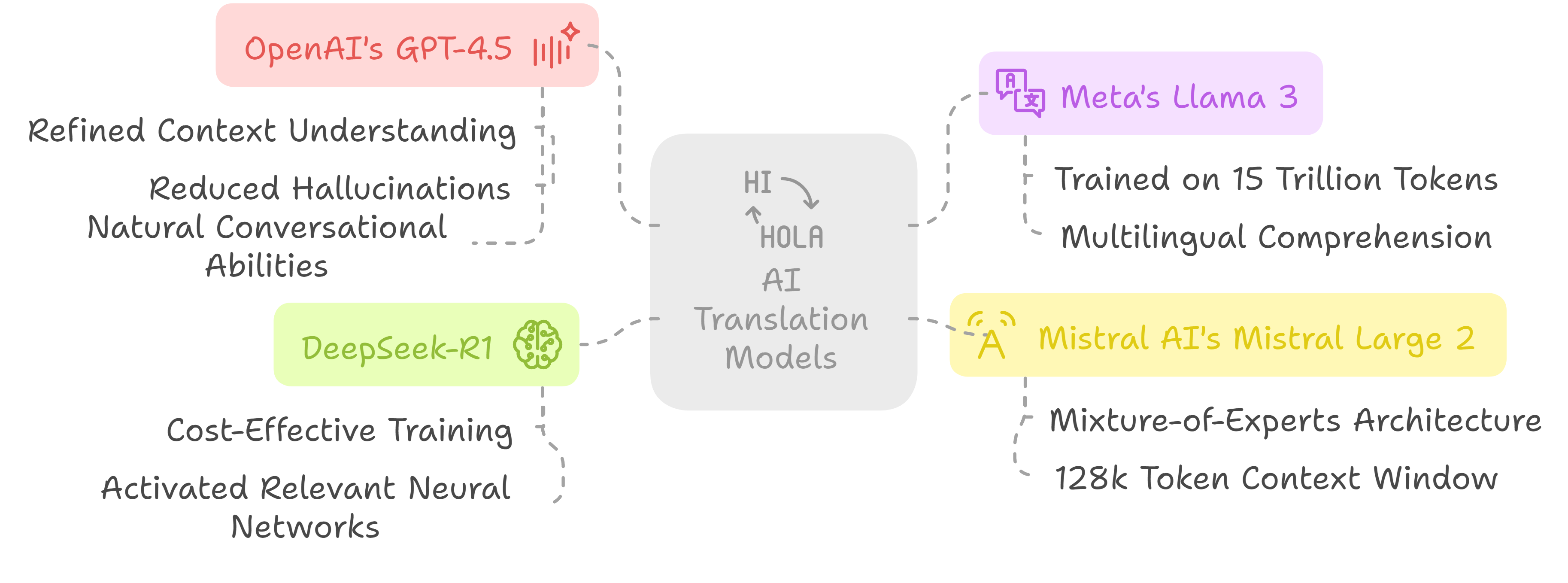
The year 2025 marks an extraordinary advancement in AI language models, fundamentally reshaping the landscape of machine translation. Today’s cutting-edge models deliver translations of unprecedented accuracy, multilingual capability, and contextual awareness. Key Advancements in 2025 AI Translation Models Enhanced Capabilities of Leading Models OpenAI’s GPT-4.5 is a powerful successor to GPT-4, boasting refined context understanding, reduced hallucinations, and more natural conversational abilities. It excels in nuanced and complex translations, often nearing human accuracy. Meta’s Llama 3 is an open-source model trained on a massive 15 trillion tokens, specifically designed to improve multilingual comprehension across 40+ languages. It has proven competitive with leading proprietary models, making it an ideal foundation for high-quality, privacy-sensitive translation projects. Mistral AI’s Mistral Large 2 employs a mixture-of-experts (MoE) architecture with an extraordinary 128k token context window, facilitating highly accurate translations of lengthy documents and complex texts. DeepSeek-R1, developed by China’s DeepSeek, achieves remarkable translation quality and efficiency by activating only relevant neural networks. Multilingual and Culturally Aware Translations Models like GPT-4.5 and Meta’s Llama 3 are now thoroughly multilingual, supporting languages as diverse as Arabic, Swahili, and Yoruba. GPT-4.5 consistently outperforms GPT-4o across multiple languages, improving translation accuracy significantly. ...

March 13, 2025 · 4 min · 725 words · Pavel Nasovich

Claude Code vs GitHub Copilot Agent: A Deep Dive Comparison of AI-Powered Coding Assistants

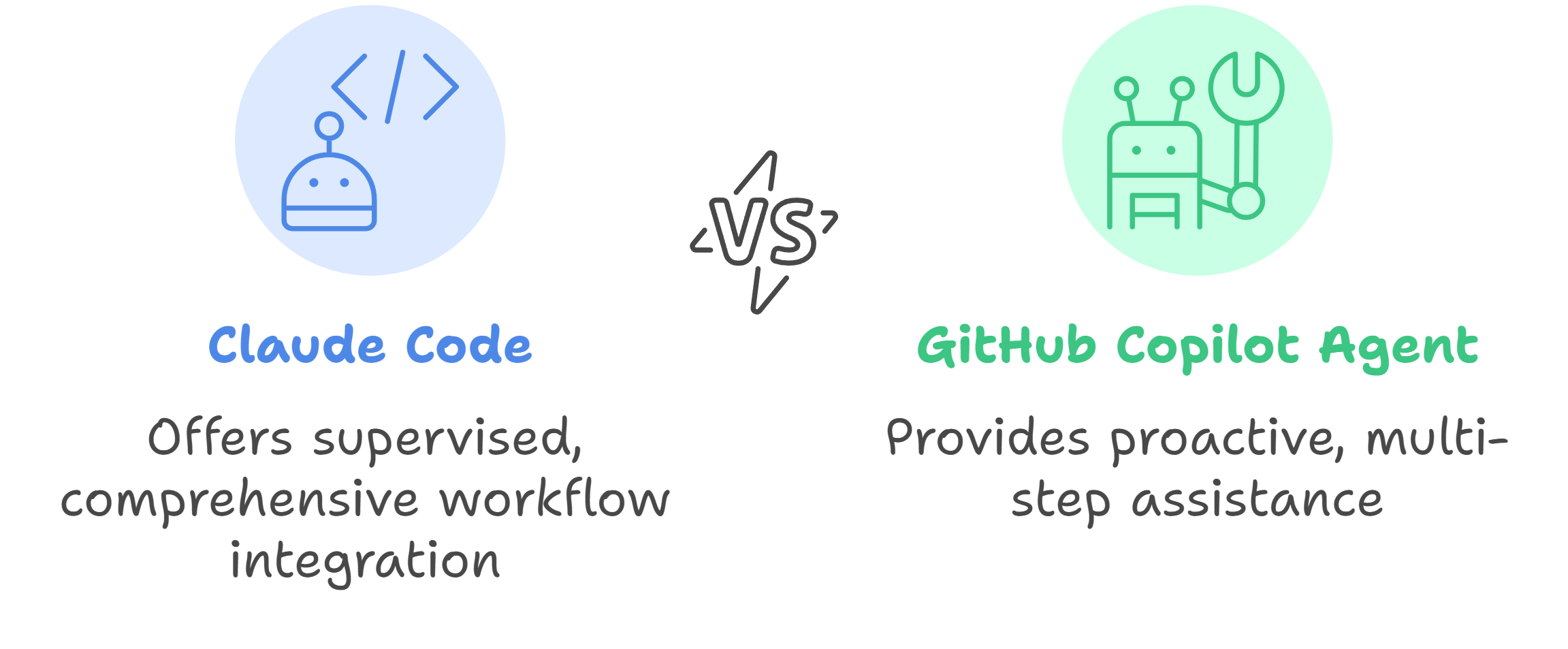
The advent of AI coding assistants has marked a paradigm shift in modern software development, transforming the coding process from a purely manual endeavor to a collaborative effort between human ingenuity and artificial intelligence. Initially emerging as sophisticated autocomplete tools, these assistants have rapidly evolved into intelligent “pair programmers,” significantly enhancing developer productivity and workflow efficiency. GitHub Copilot, launched in 2021, spearheaded this revolution by seamlessly integrating AI directly into developers’ Integrated Development Environments (IDEs), providing context-aware code suggestions and completions. By 2023, Copilot had become an indispensable tool for many, reportedly generating an average of 46% of developers’ code in enabled files and contributing to productivity gains of up to 55%. Building upon this foundation, early 2025 witnessed the arrival of a new generation of agentic coding assistants, designed to offer even more autonomous and proactive support: Claude Code and GitHub Copilot Agent. GitHub Copilot’s “agent mode,” introduced as a preview in February 2025, expanded Copilot’s capabilities beyond reactive suggestions to encompass more proactive and multi-step coding assistance. Concurrently, on February 24, 2025, Anthropic unveiled Claude Code, a “supervised coding agent” engineered to actively participate in comprehensive software development workflows. These near-simultaneous launches signify a pivotal moment, ushering in an era where AI can autonomously manage multi-stage development tasks and deeply integrate with complex codebases. ...

March 12, 2025 · 48 min · 10167 words · Pavel Nasovich

Synthetic RAG Index Lite: Extract and Synthesize

Why Synthetic RAG Index Lite? In the fast-moving landscape of large language models (LLMs) and retrieval-augmented generation (RAG), it’s essential to have a straightforward yet powerful tool. Microsoft’s Synthetic RAG Index is a robust solution for indexing and compressing large amounts of data, but sometimes you just need core functionalities without a full-stack deployment. That’s where Synthetic RAG Index Lite steps in. Key Goals: Lightweight Implementation: Keep the essential steps - extract, synthesize, and index - without the overhead of more advanced serverless architecture. Multi-Provider Support: Integrate easily with multiple LLM providers using LiteLLM to choose the best model for your use case. User-Friendliness: Provide clear commands, environment configurations, and minimal friction for setup. This Lite version preserves the spirit and core ideas from Microsoft’s original Synthetic RAG Index, while introducing simpler structures for smaller-scale or quick-turnaround projects. It respects the seminal work that inspired it, yet provides a tailored alternative for those seeking a direct, minimal solution. ...

March 10, 2025 · 5 min · 892 words · Pavel Nasovich

Ollama Minions: Merging Local and Cloud LLMs for Next-Gen Efficiency

TL;DR Ollama Minions is a framework that orchestrates hybrid local-cloud inference for large language models. Instead of sending an entire, possibly massive document to the cloud model for processing (which can be prohibitively expensive and raises privacy concerns), Minions enables your local LM - for instance, Llama 3.2 running on your own machine - to handle most of the input. The cloud model (such as GPT-4o) is called upon only when necessary for advanced reasoning, ensuring minimal API usage and associated costs. ...

March 7, 2025 · 7 min · 1360 words · Pavel Nasovich

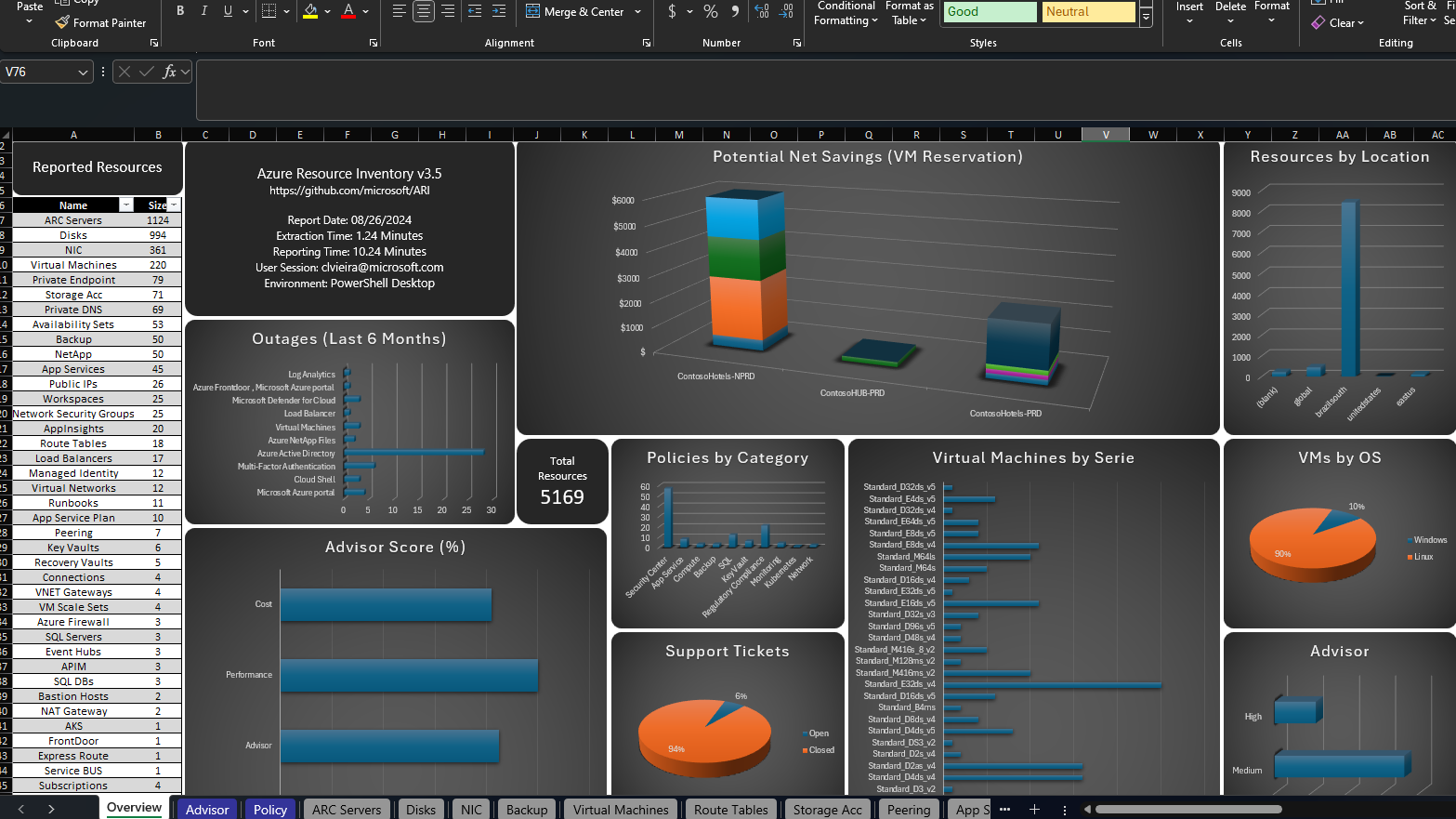
Azure Resource Inventory (ARI): Your Comprehensive Guide to Efficient Cloud Management

Introduction: Why Azure Resource Inventory Matters With Azure’s vast ecosystem of virtual machines, storage accounts, databases, networks, and countless other services, keeping track of all deployed resources can be challenging. Azure Resource Inventory (ARI) addresses this problem head-on, collecting details from multiple subscriptions and generating an Excel workbook that breaks down each resource type - complete with security recommendations, cost insights, and more. This single consolidated report is a game-changer for cloud administrators, helping them govern infrastructure, optimize costs, and streamline audits. ...

February 26, 2025 · 7 min · 1339 words · Pavel Nasovich

Browser Use: A Deep Dive into AI-Driven Browser Automation for the Future of RPA

Functionality and Architecture Browser-use is an open-source AI-powered browser automation framework that lets AI agents control a web browser via natural language instructions. Under the hood, it combines large language models (LLMs) with a headless browser automation engine (built on Playwright/Chromium) to interpret tasks and perform web interactions autonomously . When given a task, the Browser-use Agent uses an LLM (like GPT-4o or Claude) to analyze the goal and the current webpage, then issues browser commands (clicks, form fills, navigation, etc.) to achieve that goal. ...

February 23, 2025 · 33 min · 6966 words · Pavel Nasovich

EU Cyber Resilience Act (CRA) Compliance: Summary and Detailed Analysis

Summary The EU Cyber Resilience Act (CRA) is a groundbreaking regulation establishing mandatory cybersecurity standards for most hardware and software products with digital elements in the EU. It aims to embed cybersecurity “by design and by default” across the product lifecycle – from development through post-sales support – to safeguard consumers and businesses from insecure technology (Cyber Resilience Act | Shaping Europe’s digital future) (The EU Cyber Resilience Act: Implications for Companies). The CRA applies broadly to connected products (including IoT devices, software, and hardware) offered on the EU market, imposing obligations on manufacturers (and other supply-chain operators) to ensure ongoing product security and swift vulnerability management. Key principles include secure product design, regular security updates for at least 5 years, incident and vulnerability reporting within 24 hours, and increased accountability via CE marking and documentation. Non-compliance can trigger fines up to €15 million or 2.5% of global turnover (Council of the European Union Adopts the Cyber Resilience Act). The CRA complements existing EU laws like GDPR, NIS2, and the proposed AI Act, closing gaps and creating a more cohesive cybersecurity framework. This report provides both a high-level overview and an in-depth breakdown of CRA’s scope, requirements, and implications, with tailored guidance for tech companies, IoT manufacturers, and financial institutions on achieving compliance in a cost-effective, phased manner. ...

February 15, 2025 · 75 min · 15951 words · Pavel Nasovich

How to remove fields from JSON dynamically in dotnet using Json.Net

TL;DR Just parse JSON into a JToken, somehow try to match property names. Wherever there’s a match, you can remove the property from its parent object. RemoveFromLowestPossibleParent Use method RemoveFromLowestPossibleParent from nice JsonExtensions class from Brian Rogers stackoverflow answer Code public static partial class JsonExtensions { public static TJToken RemoveFromLowestPossibleParent<TJToken>(this TJToken node) where TJToken : JToken { if (node == null) return null; JToken toRemove; var property = node.Parent as JProperty; if (property != null) { // Also detach the node from its immediate containing property -- Remove() does not do this even though it seems like it should toRemove = property; property.Value = null; } else { toRemove = node; } if (toRemove.Parent != null) toRemove.Remove(); return node; } public static IEnumerable<TJToken> RemoveFromLowestPossibleParents<TJToken>(this IEnumerable<TJToken> nodes) where TJToken : JToken { var list = nodes.ToList(); foreach (var node in list) node.RemoveFromLowestPossibleParent(); return list; } } Json field name from lambda expression Using PropertyHelper<YourClass>.GetJsonName(c => c.Id) on property with JsonPropertyAttribute attribute will return you json field name for this property. ...

February 17, 2022 · 2 min · 308 words · Pavel Nasovich

How to run Docker inside a virtual machine with Windows 10 in Unraid

TL;DR Shutdown all VMs than run modprobe -r kvm_intel and modprobe kvm_intel nested=1 in unraid terminal. After that add <feature policy='require' name='vmx'/> to the CPU Section of target VM. VM Make sure that all VM are stopped. Wait a little bit after stopping. Open the Unraid Terminal Run the following via a terminal in unraid (SpaceInvader’s thank you!) #!/bin/bash modprobe -r kvm_amd modprobe kvm_amd nested=1 echo "Nested vms are enabled for AMD cpus" sleep 10 exit Open VM Settings -> Toggle XML View Add feature to to the CPU Section ...

November 21, 2021 · 1 min · 106 words · Pavel Nasovich