Preface: How I Read This Research Pack
The local research bundle on RunAnywhere is broad, but it is not uniform. Some files are direct performance summaries, some are opinionated strategy memos, and some are clearly derivative study aids built from the same underlying source set. After reading the full bundle, then re-checking the public web evidence on March 12, 2026, my conclusion is narrower and more useful:
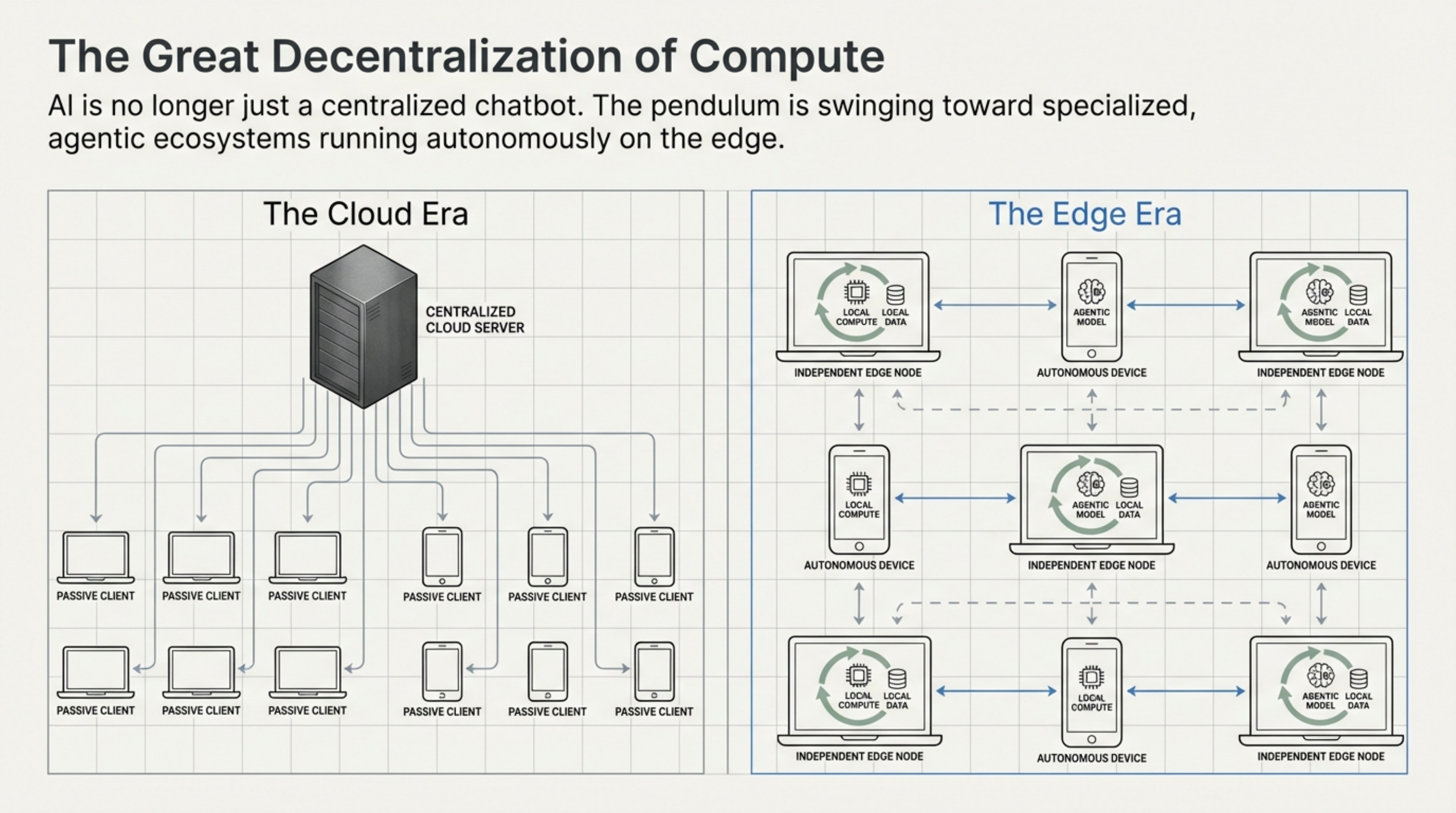
RunAnywhere is not just a “fastest inference on Apple Silicon” demo. It is trying to become the runtime, packaging, and fleet-management layer for on-device AI, with MetalRT acting as the Apple-Silicon flagship proof point. S1 S2 S3 S4
That distinction matters. If you only look at the 658 tok/s headline, you miss the larger business move. If you only look at the SDK and control-plane story, you miss why the Apple-Silicon narrative is getting attention in the first place. S2 S10
1. Reality Check: What Is Public As of March 12, 2026
RunAnywhere is an active Y Combinator Winter 2026 company, founded in 2025, describing itself as “the production-grade infrastructure for running AI on every device.” The YC launch copy is explicit that the company is not selling a single local model wrapper; it is selling a unified SDK plus rollout, routing, and observability infrastructure for on-device AI across mobile and edge environments. S1
The currently public stack breaks down like this:
| Public artifact | What it proves | Why it matters |
|---|---|---|
| YC company page | RunAnywhere positions itself as infrastructure plus hybrid routing and control plane | This is a platform story, not only a benchmark story S1 |
| RunAnywhere website | SDK-first product across iOS, Android, web, React Native, Flutter, with OTA updates and policy-based routing | The company is chasing deployment pain, not just inference speed S2 |
| RunAnywhere docs | Inference is local after model download, but anonymous analytics are collected by default | “On-device” does not automatically mean “zero network traffic under defaults” S3 |
runanywhere-sdks repo | Cross-platform SDKs with LLM, STT, TTS, VLM, voice agent, and diffusion support | The public developer surface is much broader than MetalRT alone S4 S6 |
RCLI repo | macOS-native voice AI with local RAG, 38 macOS actions, and MetalRT integration | This is the clearest public Apple-Silicon reference implementation S7 S9 |
| RunAnywhere benchmark blogs | Vendor-run decode, STT, TTS, and first-audio benchmark claims | Useful evidence, but still vendor-controlled evidence S10 S11 S12 |
Two datapoints are especially relevant for adoption timing:
- The public
runanywhere-sdksrepo had roughly 10.2k stars and had been updated on March 11, 2026. S6 - The public
RCLIrepo had roughly 858 stars, with v0.3.4 released on March 11, 2026. S8 S9
That makes RunAnywhere more than a pitch deck. There is real code, real docs, and a visible public surface area. The tradeoff is that the public story is split across multiple repos and product layers, which makes quick evaluation harder than the homepage suggests. S2 S4 S7
2. What RunAnywhere Actually Ships
The most important thing to understand is that RunAnywhere appears to have two different product centers of gravity:
- A cross-platform SDK and control-plane layer for shipping on-device AI inside products.
- A macOS-first, Apple-Silicon-optimized runtime story centered on
RCLIand MetalRT.
The homepage and YC materials emphasize the first. The benchmark blogs emphasize the second. Both are true, but they solve different buyer problems. S1 S2 S10
2.1 The cross-platform SDK story
The docs and SDK repo present RunAnywhere as a developer platform for embedding AI directly into applications across Swift, Kotlin, Web, React Native, and Flutter. The stable/beta platform split is public, and the SDK surface spans:
- LLM chat
- speech-to-text
- text-to-speech
- voice agents
- tool calling
- vision-language models
- image generation / diffusion S3 S4
That is a much bigger ambition than “we made one Mac inference kernel go faster.”
The website also pitches the operational layer around those SDKs: OTA model updates, fleet monitoring, real-time analytics, and policy-based routing between local and cloud. The YC launch page says the future is not “local only” but hybrid, where the SDK tries local first and can route to the cloud when the device is too old, too hot, or otherwise unsuitable. S1 S2
This is the first major tradeoff in the RunAnywhere story:
- Strength: the company is targeting the real operational pain of on-device AI, which is model lifecycle and device heterogeneity.
- Weakness: once you introduce a control plane, analytics, and hybrid routing, your story is no longer “purely offline magic.” You are now a platform vendor with policy, telemetry, and fleet-governance questions to answer. S2 S3
2.2 The licensing stack is more restrictive than the marketing suggests
This is the most important non-benchmark finding from the research.
RCLI is licensed under MIT. MetalRT binaries are under a separate proprietary binary license. But the flagship SDK repo, runanywhere-sdks, is not plain Apache 2.0. It ships under a custom RunAnywhere License that grants Apache-2.0-style rights only to individuals, non-commercial users, nonprofits, government, open-source projects, and organizations under both a $1M funding and $1M annual revenue threshold. Larger or commercial adopters need a separate license. S5 S13 S14
That means the public adoption model looks like this:
| Component | Public license posture | Adoption implication |
|---|---|---|
RCLI | MIT | Easy to try, easy to fork, easy to inspect S7 S13 |
runanywhere-sdks | Custom source-available commercial-threshold license | Fine for evaluation, but legal review is mandatory for serious product use S5 |
MetalRT binaries | Proprietary, redistribution-restricted binary license | Clear vendor lock-in around the Apple-Silicon acceleration layer S14 |
If you are a startup or enterprise evaluating RunAnywhere, this is not a footnote. It changes procurement, legal review, and long-term platform strategy. The research bundle spends far more time on benchmark charts than on licensing. That is backwards.
3. MetalRT: Strong Vendor Evidence, Not Yet Independent Proof
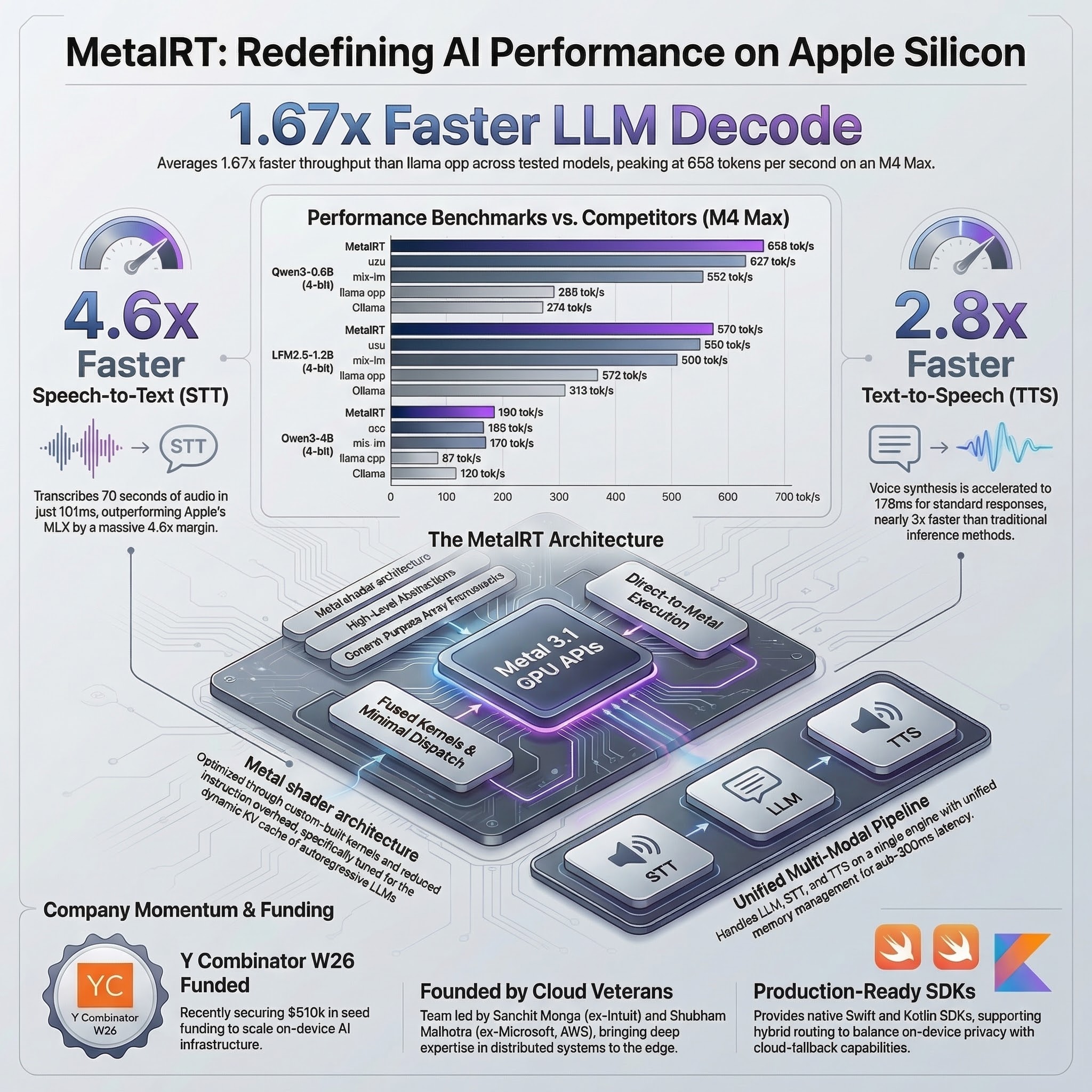
The March 3, 2026 RunAnywhere benchmark post is better than most vendor benchmark posts because it actually discloses the essentials:
- Hardware: Apple M4 Max, 64 GB unified memory, macOS 26.3
- Models: Qwen3-0.6B, Qwen3-4B, Llama-3.2-3B, LFM2.5-1.2B
- Method: 5 runs per engine, best reported
- Competitors:
uzu,mlx-lm,llama.cpp,Ollama - Fairness note: MetalRT and
mlx-lmuse the exact same model files S10
That does not make the benchmark independent, but it does make it inspectable.
3.1 The vendor-reported decode table
Here is the disclosed decode comparison from RunAnywhere’s own benchmark post:
| Model | MetalRT | uzu | mlx-lm | llama.cpp | Ollama | Takeaway |
|---|---|---|---|---|---|---|
| Qwen3-0.6B | 658 | 627 | 552 | 295* | 274 | MetalRT wins, but llama.cpp and Ollama use Q8 here, so this row is not fully apples-to-apples S10 |
| Qwen3-4B | 186 | 165 | 170 | 87 | 120 | MetalRT wins on a model size that is more operationally relevant S10 |
| Llama-3.2-3B | 184 | 222 | 210 | 137 | 131 | uzu wins this one, and RunAnywhere says so publicly S10 |
| LFM2.5-1.2B | 570 | 550 | 509 | 372 | 313 | MetalRT wins again, but still within a closer band vs uzu and MLX than the headline suggests S10 |
* RunAnywhere’s note: the Qwen3-0.6B llama.cpp and Ollama runs used Q8_0, making that row not directly comparable. S10
The best summary of the benchmark is not “RunAnywhere proved it is categorically fastest.” It is this:
RunAnywhere disclosed a credible vendor benchmark showing MetalRT winning decode on 3 of 4 tested models on one M4 Max setup, with the cleanest comparison being against MLX on the same model files.
That is meaningful. It is also narrower than the marketing headline.
3.2 What is strong about the benchmark
- It uses current, recognizable baselines instead of weak straw-man comparisons. S10
- It discloses one case where MetalRT does not win (
uzuon Llama-3.2-3B). S10 - It separates out the MLX comparison as a true engine-to-engine comparison on the same files. S10
3.3 What is still weak
- The benchmark is vendor-run.
- It reports best-of-five, not averages, variance, or P95.
- It covers one hardware profile.
- It does not publish a reproducible harness or raw run logs in the blog post. S10
Failure mode: teams mistake a strong benchmark blog for independent validation and standardize too early.
Mitigation: treat MetalRT as a pilot candidate, not as a default standard, until you reproduce it on your actual models, your actual prompts, and your actual device mix.
4. Voice Is Where the Story Gets More Interesting
Decode throughput is important, but it is not the best metric for voice products. RunAnywhere’s February 22, 2026 FastVoice post makes a sharper point: for conversational agents, the user feels first-audio latency, not tokens per second. S12
Their definition is operationally useful: measure the time from the end of user speech to the first audible word of the response. In that post, RunAnywhere reports 63 ms first-audio latency for an on-device voice pipeline built in C++, using:
- Silero VAD
- Whisper or Moonshine via
sherpa-onnx llama.cppfor the LLM stage- Piper for TTS
- CoreAudio output S12
That matters because it shows the company can optimize the pipeline, not only a single LLM kernel. The most interesting idea in the article is not vendor bragging; it is the claim that word-level streaming flush keeps first-audio latency nearly constant even as responses get longer. That is the kind of systems-level detail that usually comes from engineers who actually built the hot path. S12
Then, on March 9, 2026, RunAnywhere published the next step: MetalRT as a speech engine, claiming:
- 101 ms to transcribe 70 seconds of audio
- 714x real-time STT factor
- 178 ms for short-form Kokoro TTS
- 4.6x faster STT than
mlx-whisper - 2.8x faster TTS than
mlx-audioS11
Again, these are vendor numbers. But there is a technically interesting sequence here:
- First, RunAnywhere showed a strong voice-pipeline latency story with open components. S12
- Then it showed a faster Apple-Silicon-specific acceleration story for LLM decode. S10
- Then it folded STT and TTS into the same MetalRT narrative. S11
That sequence is coherent. It suggests RunAnywhere understands that voice agents live or die by the entire latency chain:
flowchart LR
  MIC["Microphone input"] --> VAD["VAD / speech segmentation"]
  VAD --> STT["Streaming STT"]
  STT --> LLM["LLM decode + tool routing"]
  LLM --> RAG["Local RAG / app context"]
  RAG --> TTS["Streaming TTS"]
  TTS --> AUDIO["First audible response"]
Tradeoff: voice optimization creates the strongest user experience moat, but it is also the easiest place to hide benchmark shortcuts.
Failure mode: you optimize one stage in isolation, then discover your user-perceived latency is still poor because TTS flushing, buffer management, or device thermals dominate.
Mitigation: benchmark first-audio latency, TTFT, decode, and end-to-end tool completion together, not separately.
5. Where RunAnywhere Fits Relative to MLX and llama.cpp
The public competitor set is clearer when you stop treating everything as one category.
MLX is Apple’s array framework for machine learning on Apple Silicon. It offers Python, C++, C, and Swift APIs and is deeply aligned with Apple’s unified-memory model. It is a framework choice as much as an inference choice. S15 S16
llama.cpp, by contrast, is the universal local inference workhorse. Apple Silicon remains a first-class target in that project, but its mission is portability and breadth, not Apple-only vertical optimization. S17 S18
That makes the decision model look like this:
| If your real goal is… | Start with… | Why | Main tradeoff |
|---|---|---|---|
| Researching, prototyping, or fine-tuning on Apple Silicon | MLX / MLX-LM | Native Apple framework with broad researcher-oriented APIs S15 S16 | Less opinionated product scaffolding |
| Running almost any local model, anywhere, with maximum portability | llama.cpp or Ollama | Broad model/runtime support and huge ecosystem S17 | Less vertical optimization for one hardware family |
| Shipping AI features inside a mobile app with model delivery and runtime abstraction | RunAnywhere SDKs | Cross-platform SDK + lifecycle + control-plane pitch S2 S3 S4 | Mixed licensing and product-vendor dependency |
| Building a macOS-native voice agent with deep Apple integration | RCLI + MetalRT on M3+ | Strongest public RunAnywhere reference stack S7 S10 S11 | Mac-only, M3+ for MetalRT, proprietary binary |
My synthesis after reading both the local pack and the public sources:
RunAnywhere’s moat is probably not “we are 1.19x faster than MLX forever.”
It is more likely a combination of:
- packaging multiple local AI capabilities behind one developer surface,
- solving OTA and lifecycle issues across device fleets,
- exposing hybrid routing as a policy problem instead of an app-level rewrite,
- and proving that an Apple-specific fast path can materially improve user experience on high-end Macs. S1 S2 S10
That is a stronger and more defensible story than raw benchmark theater.
6. Three Concrete Implementation Patterns
6.1 Privacy-first mobile copilot
This is the cleanest RunAnywhere use case: put LLM, STT, and TTS inside a mobile app without rebuilding the runtime plumbing from scratch. The public Swift example is deliberately simple:
import RunAnywhere
import LlamaCPPRuntime

LlamaCPP.register()
try RunAnywhere.initialize()
try await RunAnywhere.downloadModel("smollm2-360m")
try await RunAnywhere.loadModel("smollm2-360m")

let response = try await RunAnywhere.chat("What changed in our policy?")
This pattern makes sense when latency, privacy, and offline capability matter more than frontier-model quality. S4
Tradeoff: once you adopt the SDK surface, you are also adopting RunAnywhere’s packaging and licensing model. S5
Failure mode: teams assume all devices behave the same way and ignore memory, thermal, and fallback behavior.
Mitigation: use device-tier policies from day one and measure local success rate versus fallback rate across your real hardware fleet. The YC launch copy is explicit that device heterogeneity is the problem they are trying to solve. S1 S2
6.2 macOS operator assistant
RCLI is the most convincing public demo because it is not abstract. It is a concrete macOS assistant with local RAG, tool calling, and 38 macOS actions:
rcli
rcli listen
rcli ask "open Safari"
rcli ask "play some jazz on Spotify"
rcli metalrt
rcli llamacpp
The public README also claims:
- local RAG over PDFs, DOCX, and text
- roughly 4 ms hybrid retrieval over 5K+ chunks
- automatic
llama.cppfallback on M1/M2 - MetalRT requiring M3 or later S7
Tradeoff: this is a highly opinionated, Mac-native surface. That is good for UX and bad for portability.
Failure mode: you fall in love with the demo on an M4 Max and then try to roll it out to an M1/M2-heavy fleet.
Mitigation: treat M3+ as a premium tier, keep llama.cpp fallback operational, and benchmark per cohort before rollout. S7
6.3 Hybrid mobile-and-edge fleet
This is where the platform story becomes more important than MetalRT itself.
The public website and YC page both describe a future where teams define routing policies across local and cloud, push OTA model updates, and monitor a fleet from a control plane. S1 S2
This pattern fits teams building:
- privacy-sensitive mobile copilots,
- edge agents in patchy-network environments,
- or products that want “local first, cloud when needed” behavior without hand-rolling every lifecycle edge case. S1 S2
Tradeoff: hybrid routing gives you resilience, but it also makes governance harder because you now need a clear policy for when user data stays local and when it can leave the device.
Failure mode: the product team markets “fully on-device” while the platform team quietly enables analytics or cloud fallback under defaults.
Mitigation: define routing policy, telemetry policy, and legal copy together. The docs are clear that inference can be local while anonymous analytics are still enabled by default. S3
7. Operational Risks That Matter More Than Another Benchmark
The local research reports spend a lot of time on TCO and strategic impact tables. Some of that is directionally useful, but the more important risks are simpler and closer to the product surface.
7.1 Mixed licensing risk
The SDK is source-available with commercial thresholds, RCLI is MIT, and MetalRT is proprietary. That is manageable, but only if procurement and engineering both understand it before implementation begins. S5 S13 S14
7.2 Hardware-fragmentation risk
MetalRT currently requires M3 or later. That is fine if you are targeting high-end Apple-Silicon users, but it is a real fleet-segmentation constraint for broader enterprise rollouts. S7
7.3 Benchmark-independence risk
The public benchmark evidence is strong enough to justify a pilot, not strong enough to justify a category conclusion. If your use case is economically sensitive to a 10-20% speed gap, rerun it yourself. S10 S11
7.4 Messaging-versus-operations risk
RunAnywhere says “No cloud. No latency. No data leaves the device” on the SDK marketing surface, but the docs also say anonymous analytics are collected by default, and the broader product story includes hybrid routing and a control plane. Those can all be true at once, but only if the implementation and customer messaging are precise. S2 S3
8. The Observability Model I Would Require Before Production
RunAnywhere’s public site emphasizes analytics and fleet monitoring, which is the right direction. But if I were operating this stack in production, I would insist on a minimum telemetry contract like this:
| Metric | Why it matters | Suggested target |
|---|---|---|
| On-device success rate | Measures how often requests finish locally without fallback | >95% for the device tier you are targeting |
| Fallback rate by device class | Detects thermal, memory, or compatibility failures | Stable and explainable by hardware cohort |
| P95 TTFT | Protects perceived responsiveness for chat | <75 ms for small local models on premium devices |
| First-audio latency | The real UX metric for voice | <150 ms for short assistant turns |
| P95 local retrieval latency | Keeps RAG from becoming the hidden bottleneck | <10 ms if you are claiming “instant” document workflows |
| Crash-free session rate | Detects runtime instability faster than anecdotal bug reports | >99% |
| Model download failure rate | Validates OTA and lifecycle reliability | trending toward zero after initial rollout |
| Per-model adoption and abandonment | Shows which models users actually trust | measured weekly, not quarterly |
These are proposed operating targets, not public RunAnywhere SLOs.
Failure mode: teams measure only tokens per second and ignore fleet health.
Mitigation: treat latency, crash rate, fallback rate, and user trust as first-class metrics from pilot day onward.
9. A Practical 90-Day Rollout Plan
If I were advising a team evaluating RunAnywhere today, I would not start with procurement. I would start with proof.
Days 0-30: Prove the workload
- Pick one use case only: mobile copilot, Mac operator assistant, or voice workflow.
- Benchmark your current baseline with MLX or
llama.cpp. - Re-run the critical path on the exact devices you plan to support.
- Add legal review immediately for the SDK license. S5
Checkpoint:
- You know whether the problem is really inference speed, lifecycle pain, or fleet heterogeneity.
Days 31-60: Pilot the platform
- Test
RCLIseparately from the SDK if Apple-Silicon voice is part of the roadmap. - Validate local-first behavior and document any fallback conditions.
- Decide whether anonymous analytics are acceptable under your policy posture. S3
- Confirm whether M3+ segmentation is a feature or a blocker. S7
Checkpoint:
- You have real latency, fallback, and failure data by device cohort.
Days 61-90: Productize or walk away
- If the SDK reduces integration time materially, negotiate commercial terms.
- If MetalRT actually moves your user-facing latency enough to matter, keep it in scope.
- If the platform benefits are real but the proprietary pieces are too constraining, fall back to MLX or
llama.cppand keep the operational lessons.
Checkpoint:
- You have an adoption decision based on product fit, legal fit, and measured performance, not GitHub stars or hype.
10. Final Take
RunAnywhere is interesting because it is aiming at the part of on-device AI that most teams underestimate: not the model itself, but the runtime, lifecycle, fallback, routing, and fleet problem around the model.
MetalRT is part of that story, and the public vendor benchmarks are credible enough to take seriously. But the stronger thesis is not “RunAnywhere has a magic Apple-Silicon kernel.” It is:
If RunAnywhere can make on-device AI feel operationally boring to ship, then the benchmark advantage becomes a multiplier instead of the whole product.
That is a better business. It is also a better reason to pay attention.