
As of April 18, 2026, the latest revision in my local clone of microsoft/skills-for-copilot-studio is commit 5c1cc83, tagged v1.0.8, with recent release-process work merged on April 14-16, 2026. Microsoft also labels the repository an experimental research project, which is the right framing: this is not a finished product so much as a serious attempt to make Copilot Studio agents behave like code instead of opaque portal artifacts. S1 S3 S4 S17
That distinction matters more than it sounds. Copilot Studio has always had a tension between low-code authoring and engineering discipline. This repo picks a side. It says an agent should live as a folder-backed YAML bundle, should be editable by AI coding tools, should be checked against schema and runtime constraints, and should move through a repeatable clone -> author -> validate -> push -> publish -> test loop. S1 S2 S5 S8
My take after digging through the repo is simple: Skills for Copilot Studio is most interesting not because it generates YAML, but because it tries to turn prompt-driven authoring into a controlled software-delivery system. The quality comes from the constraints: specialized sub-agents, hook-injected context, template-backed skills, LSP validation, and scenario evals. The tradeoff is equally clear: you do not get pure freedom. You get a safer, narrower, more opinionated lane. S5 S6 S7 S15
At a Glance
- This repo treats a Copilot Studio agent as a multi-file codebase, not a single exported blob. S8 S9
- The product surface is organized around four specialized commands: manage, author, test, and troubleshoot. S1 S2
- The authoring system is schema-first and intentionally conservative: skills are supposed to look up kinds, use templates, and validate after edits. S5 S8 S9
- The plugin is YAML-native, but not YAML-only. Some things still require the Copilot Studio UI, especially authenticated connector and MCP connections. S2 S10 S11
- The repo has a meaningful eval harness for authoring flows, but it still lacks hard CI gating and full coverage for all external integration scenarios. S3 S15 S16
- The most important architectural idea is this: AI coding tools should manage Copilot Studio with scoped skills and runtime checks, not with free-form prompting. S5 S6 S8
The Core Architecture
This repository wraps Copilot Studio in a layered control plane:
flowchart LR
  A["AI coding tool<br/>Claude Code / Copilot CLI / VS Code"] --> B["Session hooks<br/>system prompt + setup"]
  B --> C["Specialized agents<br/>manage / author / test / troubleshoot"]
  C --> D["Skill layer<br/>templates, schema lookup, connector lookup"]
  D --> E["Local agent bundle<br/>agent.mcs.yml + settings + topics/actions/knowledge"]
  E --> F["VS Code Copilot Studio extension<br/>LanguageServerHost + auth"]
  F --> G["Copilot Studio cloud<br/>draft, publish, test"]
The purpose of this stack is to reduce ambiguity. A plain LLM prompt has too much freedom and too little structure for a schema-heavy platform like Copilot Studio. This repo narrows the authoring surface until the model is working against a set of explicit conventions rather than guessing. S5 S6 S8 S9
The first tradeoff shows up immediately: the plugin is not trying to generate an entire Copilot Studio project from thin air. The author agent explicitly refuses to create a brand-new agent if there is no existing agent.mcs.yml in the workspace. You are expected to clone an existing agent first, then edit it safely. That sounds restrictive, but it is also one of the smartest design decisions in the repo, because it ties local YAML back to a real environment instead of letting the model hallucinate a disconnected project skeleton. S2 S5
Failure mode: If a team treats this as “just dump YAML and pray,” they will hit schema errors, broken IDs, invalid kind values, or cloud/runtime mismatches quickly.
Mitigation: Follow the repo’s actual workflow: start from a cloned agent, let the skills route to templates and lookup tools, and validate before push. S2 S5 S8
Copilot Studio Becomes a Folder-Backed App
The most useful mental model in the repo is the project layout. Instead of seeing Copilot Studio as a portal with hidden internal state, the plugin treats it like a componentized application with typed files. S8 S9
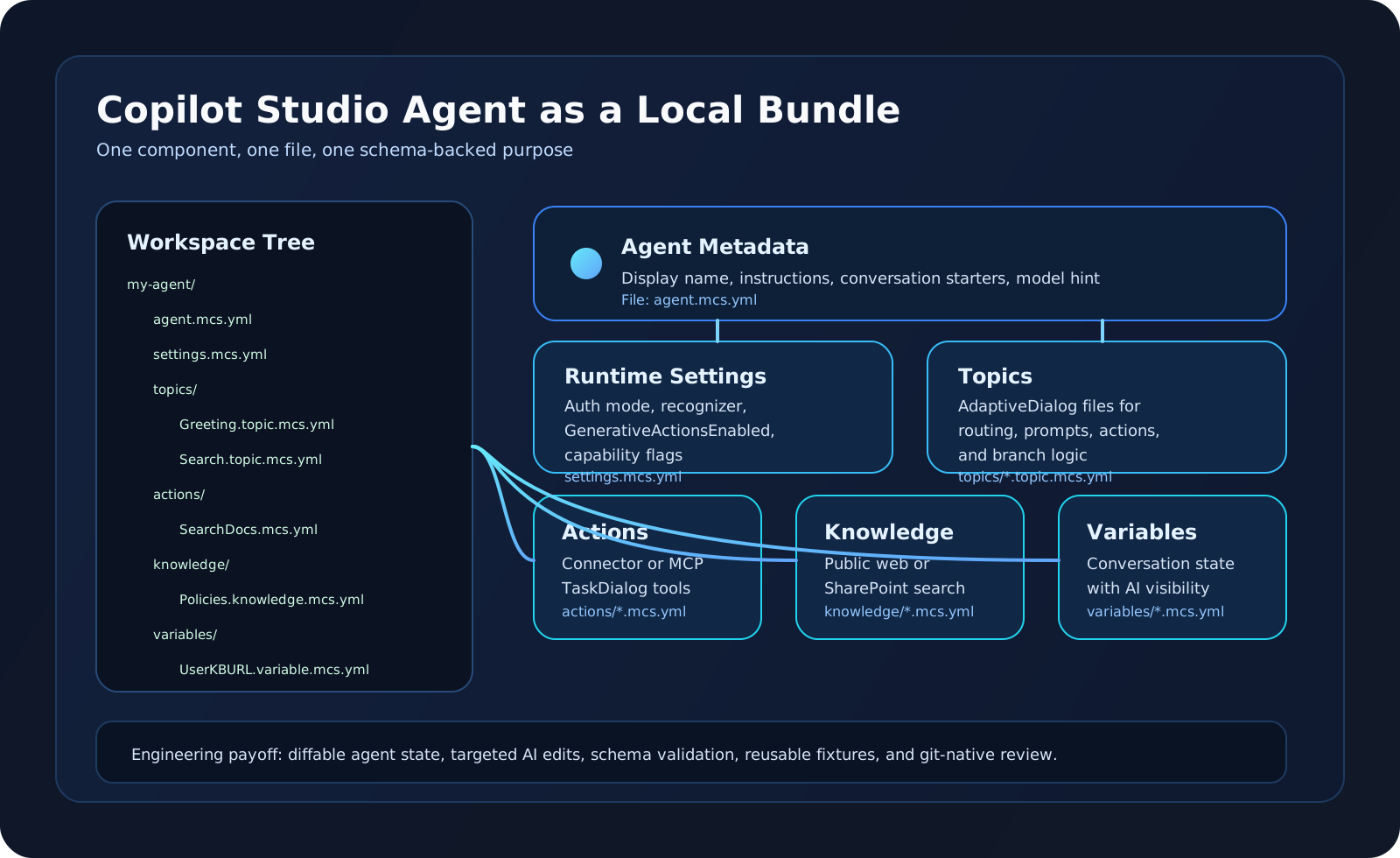
The repo’s strongest idea is structural: one component, one file, one schema-backed purpose.
| Component | Typical file | Why it matters |
|---|---|---|
| Agent metadata | agent.mcs.yml | Defines display name, instructions, conversation starters, model hint |
| Runtime settings | settings.mcs.yml | Holds flags like GenerativeActionsEnabled, auth mode, recognizer configuration |
| Topics | topics/*.topic.mcs.yml | Conversation logic via AdaptiveDialog |
| Actions | actions/*.mcs.yml | Connector or MCP-backed TaskDialog definitions |
| Knowledge | knowledge/*.knowledge.mcs.yml | Search scope and grounding sources |
| Variables | variables/*.mcs.yml | Conversation state with explicit AI visibility |
| Child agents | agents/*/*.mcs.yml | Routed external or subordinate agent behaviors |
This is where the repo stops being a neat plugin and starts being a real engineering pattern. Once an agent is represented this way, you can diff it, branch it, review it, pin versions, build eval fixtures around it, and hand pieces of it to specialized AI workers. S1 S8 S15
A minimal agent shell looks like this:
mcs.metadata:
  componentName: HelpDeskAgent
kind: GptComponentMetadata
displayName: Help Desk Agent
instructions: |
  You are a helpful IT support assistant.

  Guidelines:
  - Be concise.
  - Ask for missing details when needed.
  - Escalate when the request requires a human.
conversationStarters:
  - title: New Laptop
    text: How do I request a new laptop?
aISettings:
  model:
    modelNameHint: GPT5Chat
That example is simple, but it exposes the repo’s philosophy. The agent is expressed as plain text, with stable fields and reviewable intent. The model hint is explicit. Conversation starters are explicit. Instructions are explicit. Nothing critical is hiding behind a click path. S1 S4 S8
Inference: This structure is the real unlock for AI coding tools. Large models are much better at editing constrained, line-oriented artifacts than reverse-engineering state from a visual canvas.
Four Agents, Not One Magic Prompt
The public README presents four commands, and they are the best way to understand the product boundary:
copilot-studio-managecopilot-studio-authorcopilot-studio-testcopilot-studio-troubleshootS1
That split is not cosmetic. It is how the repo keeps the assistant from turning into one giant, sloppy super-agent. The manage path handles clone/pull/push/publish. The author path handles YAML authoring. The test path handles draft evals, point tests, and kit-based batch tests. The troubleshoot path diagnoses routing and runtime problems. S1 S2 S5
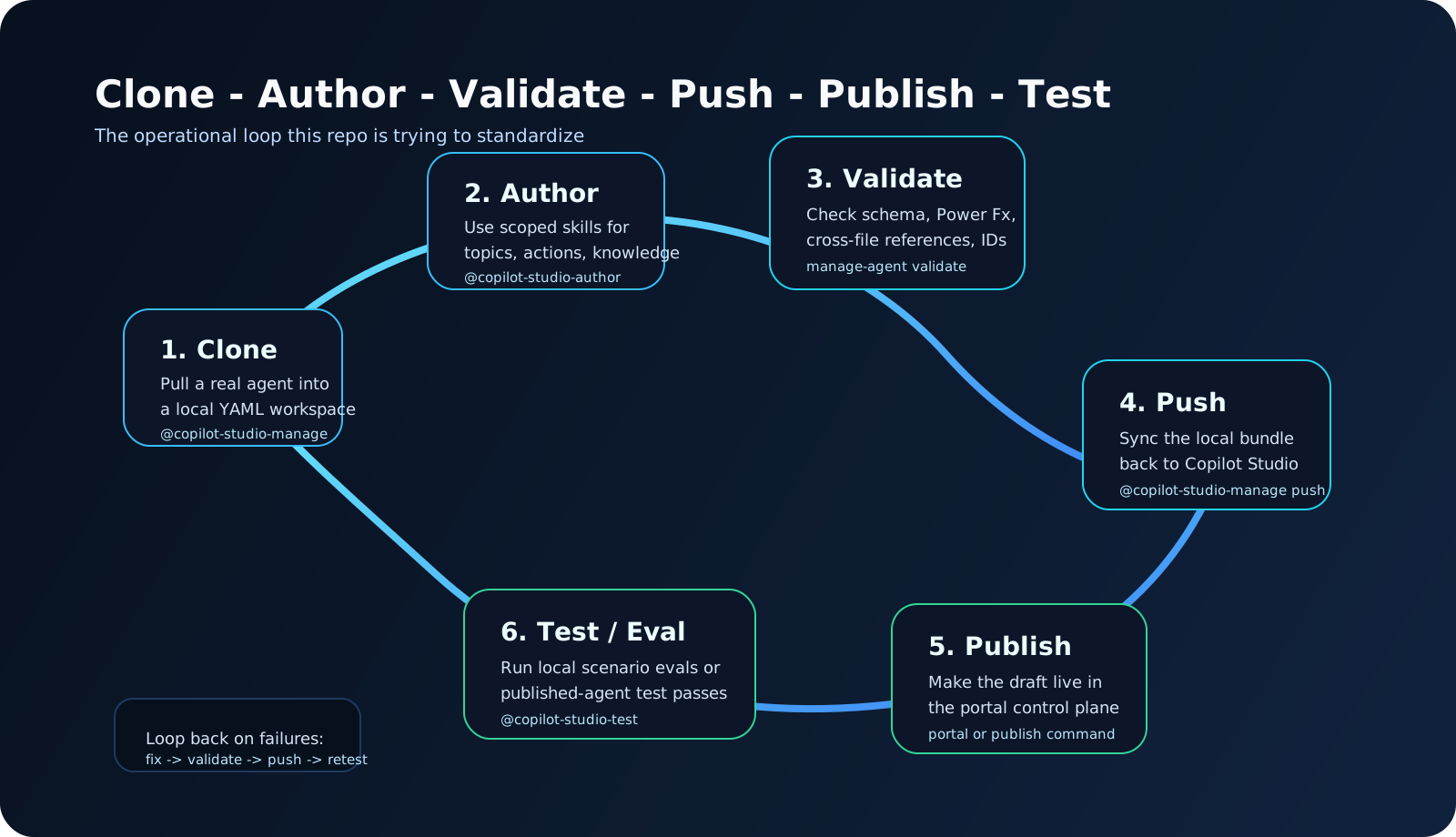
The routing discipline gets even stricter inside the repo. The author sub-agent says, in effect, “always use skills when a skill exists.” That means new topics, actions, knowledge sources, adaptive cards, validation, and schema lookup are supposed to be delegated into smaller task-specific skills instead of being hand-authored free-form. S5
sequenceDiagram
  participant U as User request
  participant M as Main assistant
  participant A as Author agent
  participant S as Skill layer
  participant V as Validation
  U->>M: "Add a topic" or "edit an action"
  M->>A: Delegate bounded authoring task
  A->>S: Invoke matching skill
  S->>S: Load template and schema context
  S->>V: Validate YAML and references
  V-->>A: Diagnostics or pass
  A-->>M: Safe edit or refusal with reason
This is the repo’s real control strategy: narrow the model through delegation, then narrow it again through skill contracts and validation.
That is the right design for Copilot Studio because the hard part is not generating text. The hard part is staying within a brittle, evolving runtime contract.
Schema-First, Not Free-Form YAML
One of the strongest engineering moves in the repo is the explicit refusal to trust memory. The internal project context skill tells the agent not to load the full schema file blindly and instead use schema-lookup.bundle.js to resolve just the relevant shapes, kinds, and references. S8
The core workflow looks like this:
node scripts/schema-lookup.bundle.js kinds
node scripts/schema-lookup.bundle.js resolve AdaptiveDialog
node scripts/manage-agent.bundle.js validate --workspace ./my-agent \
  --tenant-id <tenant> \
  --environment-id <env> \
  --environment-url <url> \
  --agent-mgmt-url <mgmt>
That matters because Copilot Studio’s YAML surface is larger and weirder than most people remember. The schema contains a long list of kind discriminators, YAML-only features, Power Fx expression rules, and runtime-specific caveats. The repo even documents that OnOutgoingMessage exists in schema but is non-functional at runtime as of March 15, 2026. That single note captures the problem perfectly: if you only trust the schema, you will still be wrong sometimes. S8 S9
Failure mode: Using the schema as if it were a full behavioral spec can produce YAML that is syntactically valid but operationally wrong.
Mitigation: Use the schema lookup tool for structure, then use the repo’s reference skills, validation step, and eval loop to catch runtime reality. S8 S9 S15
Three Patterns Worth Reusing
The repository ships a lot of templates, but three patterns stand out as genuinely reusable.
1. Fallback Search Topic
The fallback search template is the cleanest example of a grounded generative answer path:
kind: AdaptiveDialog
beginDialog:
  kind: OnUnknownIntent
  id: fallback
  priority: -1
  actions:
    - kind: CreateSearchQuery
      id: buildQuery
      userInput: =System.Activity.Text
      result: Topic.SearchQuery
    - kind: SearchAndSummarizeContent
      id: searchDocs
      variable: Topic.Answer
      userInput: =Topic.SearchQuery.SearchQuery
This is a strong pattern because it separates query formation from knowledge search. The AI rewrites the search query first, then searches the configured knowledge sources. That is better than blindly summarizing on the raw user utterance, especially when the user is being conversational or elliptical. S12
Tradeoff: It is elegant, but it only works as well as the knowledge sources behind it. Poorly scoped sources still produce poor answers.
2. MCP Action as a First-Class Tool Surface
The repo’s MCP action template is important because it shows how Copilot Studio is starting to absorb the broader agent tooling ecosystem:
kind: TaskDialog
inputs:
  - kind: ManualTaskInput
    propertyName: userid
    value: =System.User.Email
modelDisplayName: Microsoft Learn MCP
modelDescription: Search official documentation with user context
action:
  kind: InvokeExternalAgentTaskAction
  connectionReference: contoso_shared_learnmcp
  connectionProperties:
    mode: Maker
  operationDetails:
    kind: ModelContextProtocolMetadata
    operationId: InvokeMCP
This is a big deal because it turns MCP into a routed Copilot Studio action surface instead of leaving it as a totally separate ecosystem. At the same time, the repo is careful not to overpromise: you still need to create the connection through the Copilot Studio UI first. YAML can define the action shape, but it cannot conjure the authenticated connection reference on its own. S10 S14
Failure mode: Teams hear “MCP action” and assume everything is local-code-first. It is not. Connection setup remains portal-dependent.
Mitigation: Treat MCP actions as YAML-defined, UI-provisioned components. Document the connection workflow alongside the YAML.
3. Just-In-Time Context Bootstrapping
The conversation-init template is the most operationally mature topic in the repo. It uses an OnActivity trigger to fetch user profile information, populate a global variable, and optionally load glossary context from a specific knowledge source. S13
That gives you a powerful pattern: hydrate context once, then let the rest of the agent reason over variables like Global.UserCountry or Global.Glossary.
The repo pairs that nicely with dynamic knowledge-source guidance:
kind: KnowledgeSourceConfiguration
source:
  kind: SharePointSearchSource
  site: =$"{Global.UserKBURL}"
That is a much better enterprise pattern than hardcoding a single global knowledge path, because it lets the agent route by region, team, or profile-derived context. The repo explicitly documents both the static SharePoint form and the variable-driven form. S11 S13
Tradeoff: This makes grounding smarter, but it also makes initialization correctness more important. If the variable is blank when search fires, the knowledge path is blank too.
YAML-Native Does Not Mean Portal-Free
One place people will misread this repo is assuming the local YAML bundle replaces Copilot Studio entirely. It does not. The repo is strongest when you use YAML for repeatable structure and the portal for platform-managed state. S2 S10 S11
flowchart TD
  A["Need to change the agent"] --> B{"Can YAML own it?"}
  B -->|Yes| C["Topics, instructions, knowledge config,<br/>variables, action metadata"]
  C --> D["Edit locally in bundle"]
  D --> E["Validate"]
  E --> F["Push and test"]
  B -->|No| G["Portal-managed setup"]
  G --> H["Create connection reference,<br/>publish draft, inspect live behavior"]
  H --> I["Pull back into local workspace if needed"]
The plugin works best when you respect this boundary instead of trying to force every platform concern into files.
Hooks Are Doing More Than Prompt Injection
Many plugin repositories stop at prompt files. This one goes further.
The SessionStart hook chain injects the Copilot Studio system prompt and then runs a setup script that prepares plugin state on disk. The setup script copies native dependency metadata, performs dependency installation when needed, and writes plugin-path data under the user’s home directory. S6 S7
That is operationally useful for one reason: it means the assistant does not enter a Copilot Studio session empty. It starts with domain instructions and the helper scripts already discoverable.
This is also where one of the rough edges lives.
Failure mode:
First-run behavior can include dependency bootstrapping and npm install work inside plugin data directories. That introduces latency and another point of failure.
Mitigation: If you adopt this pattern internally, pre-warm the plugin environment in developer onboarding or CI images instead of making every first interactive session pay the setup tax. S7
Testing and Observability: Better Than Promptware, Not Yet CI-Hard
The repo has two distinct testing stories, and that separation is one of its strengths.
| Layer | What it tests | How it works | Why it matters |
|---|---|---|---|
evals/ | Local authoring behavior | Fixture workspaces, natural-language prompts, route assertions, file checks, HTML/JSON reports | Fast regression testing for skills and sub-agent behavior |
tests/ | Published or environment-backed agents | MSAL auth, Dataverse test runs, polling, CSV result download | Real platform validation against deployed agents |
The evals harness is the more novel of the two. It is scenario-driven, runs prompts against the CLI, checks which agent and skill got invoked, and validates file effects. That is exactly the kind of guardrail AI coding plugins need: not “did the model sound smart?” but “did it route correctly and touch the right artifact?” S15
The published-agent test runner is heavier but practical. It authenticates through MSAL device code flow, creates a Dataverse-backed test run, polls for completion, and downloads results. In other words, the repo does not stop at YAML generation; it tries to close the loop into real Copilot Studio test execution. S2 S16
The tradeoff is maturity. The release plan explicitly says there is no eval or test gating in CI yet, and the published-agent flow still depends on Azure app registration, environment access, and operational setup. This is better than toy promptware, but it is not yet “merge with total confidence” infrastructure. S2 S3 S16
A Practical SLO Model
Inference: The repo does not define SLOs, but its structure suggests the right ones for a team adopting it:
yaml_validity_rate: percentage of generated edits that pass LSP validation on first attemptauthoring_roundtrip_minutes: median time from prompt to validated local changedraft_eval_pass_rate: percent of scenario or draft eval checks passing before publishpublish_defect_escape_rate: issues found only after portal publishmanual_portal_edit_ratio: percent of fixes that still require hand-editing in the UI
If those metrics are trending the wrong way, the answer is usually not “use a bigger model.” It is “tighten skills, templates, or validation gates.”
Operational Risks and Mitigations
The repo is honest enough that its own limitations are a useful adoption checklist.
| Risk | Why it happens | Mitigation |
|---|---|---|
Wrong kind values or unsupported YAML shapes | Copilot Studio schema is broad and evolving | Force schema lookup before write; validate every edit S8 S9 |
| YAML works in file form but not in runtime | Schema truth and runtime truth are not identical | Use references plus evals, not schema alone S9 S15 |
| Connector or MCP action cannot run | Connection references are portal-created, not YAML-created | Provision through UI first, then edit locally S2 S10 |
| Agent cannot be authored from scratch | Repo intentionally requires a cloned workspace | Start from a real agent and keep cloud linkage intact S2 S5 |
| First-run setup is slow or flaky | Hook setup may install dependencies | Pre-stage plugin runtime where possible S7 |
| False confidence from local tests | CI gating is still minimal and some external integrations are hard to mock | Combine local evals with published-agent validation S3 S15 S16 |
How I Would Roll This Out on a Real Team
The point of a repo like this is not to impress a demo audience. It is to reduce delivery friction without letting AI authoring become chaos.
Inference: If I were rolling this out on an enterprise Copilot Studio team, I would do it in five checkpoints.
Establish source-of-truth discipline. Clone one real agent, commit the YAML bundle to git, and ban unmanaged portal drift except for connection provisioning and unavoidable platform-only changes.
Stabilize the local loop. Prove that clone, pull, validate, and push work consistently on at least two developer machines. Do not scale usage until the local toolchain is boring. S2 S6 S7
Adopt only a small template set first. Start with one greeting topic, one fallback search topic, one knowledge source, and one safe action. Resist the urge to expose the whole schema on day one. S12 S13 S14
Add regression pressure before velocity pressure. Wire the scenario eval harness into PR checks before you encourage aggressive AI authoring. This repo is already halfway there; most teams should finish that job internally. S3 S15
Treat the portal as the control plane, not the authoring plane. Use the UI for publish, connection setup, and visual inspection. Use YAML and git for most repeatable edits.
The checkpoint that matters most is number four. AI-assisted authoring gets dangerous when speed outruns verification.
Final Verdict
skills-for-copilot-studio is one of the more thoughtful AI-coding integrations I have seen around a low-code platform because it understands the real problem. The bottleneck is not text generation. The bottleneck is safe authoring under a changing schema, a changing runtime, and a portal-backed cloud system.
That is why the repo’s best features are not flashy:
- hook-injected context
- specialized sub-agents
- schema and connector lookup
- strict validation
- fixture-backed evals
- an explicit refusal to pretend everything can be done from scratch
If Microsoft keeps pushing this direction, Copilot Studio will become much easier to treat like a normal engineering asset: diffable, testable, reviewable, and partially automatable by strong coding models. If they stop halfway, it will remain a clever plugin around an awkward portal. Right now, as of April 2026, it is somewhere in the middle: already useful, clearly opinionated, and still unfinished in exactly the ways you would expect from a serious first-generation toolchain. S1 S2 S3 S5
Source Mapping
The article originally used S1..S17 as inline references. That is useful for precision, but the better reader-facing form is a section-level evidence map that shows what each source actually supports.
| Article section | Main claims backed here | Source IDs |
|---|---|---|
| Context and status | Current repo version is v1.0.8, latest inspected commit is 5c1cc83, and the project is explicitly experimental | S1, S3, S4, S17 |
| Core architecture | The repo is built around manage/author/test/troubleshoot delegation, hook-injected context, and a local YAML bundle | S1, S2, S5, S6, S8 |
| Folder-backed app model | Agent projects are split across agent.mcs.yml, settings.mcs.yml, topics/, actions/, knowledge/, and variables/ | S8, S9 |
| Schema-first workflow | Authoring is routed through skills, schema lookup, valid kind values, and full validation | S5, S8, S9 |
| Implementation patterns | Fallback search, JIT context hydration, dynamic knowledge routing, and MCP actions all come from shipped templates or skill docs | S10, S11, S12, S13, S14 |
| Testing and observability | The repo has local scenario evals plus environment-backed published-agent tests, but no hard CI eval gate yet | S2, S3, S15, S16 |
| Rollout guidance and risks | Portal-managed connections, runtime/schema mismatches, and setup friction are real adoption constraints | S2, S7, S9, S10, S11, S15 |
Primary Sources
| ID | Source | What it contributed | Verified |
|---|---|---|---|
S1 | README.md | Command surface, product framing, supported tools | 2026-04-18 |
S2 | SETUP_GUIDE.md | Clone/push/publish/test workflow, prerequisites, current support limits | 2026-04-18 |
S3 | RELEASE_PLAN.md | Release cadence, maturity signals, lack of CI eval gating | 2026-04-18 |
S4 | .claude-plugin/plugin.json | Current plugin version and description | 2026-04-18 |
S5 | agents/copilot-studio-author.md | No-from-scratch rule, skill-first authoring, validation discipline | 2026-04-18 |
S6 | hooks/hooks.json | SessionStart hook chain and prompt injection | 2026-04-18 |
S7 | hooks/setup.js | Dependency bootstrap and plugin runtime setup behavior | 2026-04-18 |
S8 | skills/int-project-context/SKILL.md | Folder structure, schema lookup flow, project conventions | 2026-04-18 |
S9 | skills/int-reference/SKILL.md | Trigger/action semantics, Power Fx notes, runtime caveats | 2026-04-18 |
S10 | skills/add-action/SKILL.md | MCP and connector action rules, UI-created connection requirements | 2026-04-18 |
S11 | skills/add-knowledge/SKILL.md | Knowledge-source patterns, SharePoint routing, dynamic URLs | 2026-04-18 |
S12 | templates/topics/search-topic.topic.mcs.yml | Fallback search template example | 2026-04-18 |
S13 | templates/topics/conversation-init.topic.mcs.yml | JIT context bootstrap and glossary-loading pattern | 2026-04-18 |
S14 | templates/actions/mcp-action.mcs.yml | MCP action structure example | 2026-04-18 |
S15 | evals/run.js | Scenario eval orchestration and reporting model | 2026-04-18 |
S16 | tests/run-tests.js | Published-agent test runner and Dataverse flow | 2026-04-18 |
S17 | commit 5c1cc83 | Exact repo revision used for this analysis | 2026-04-18 |