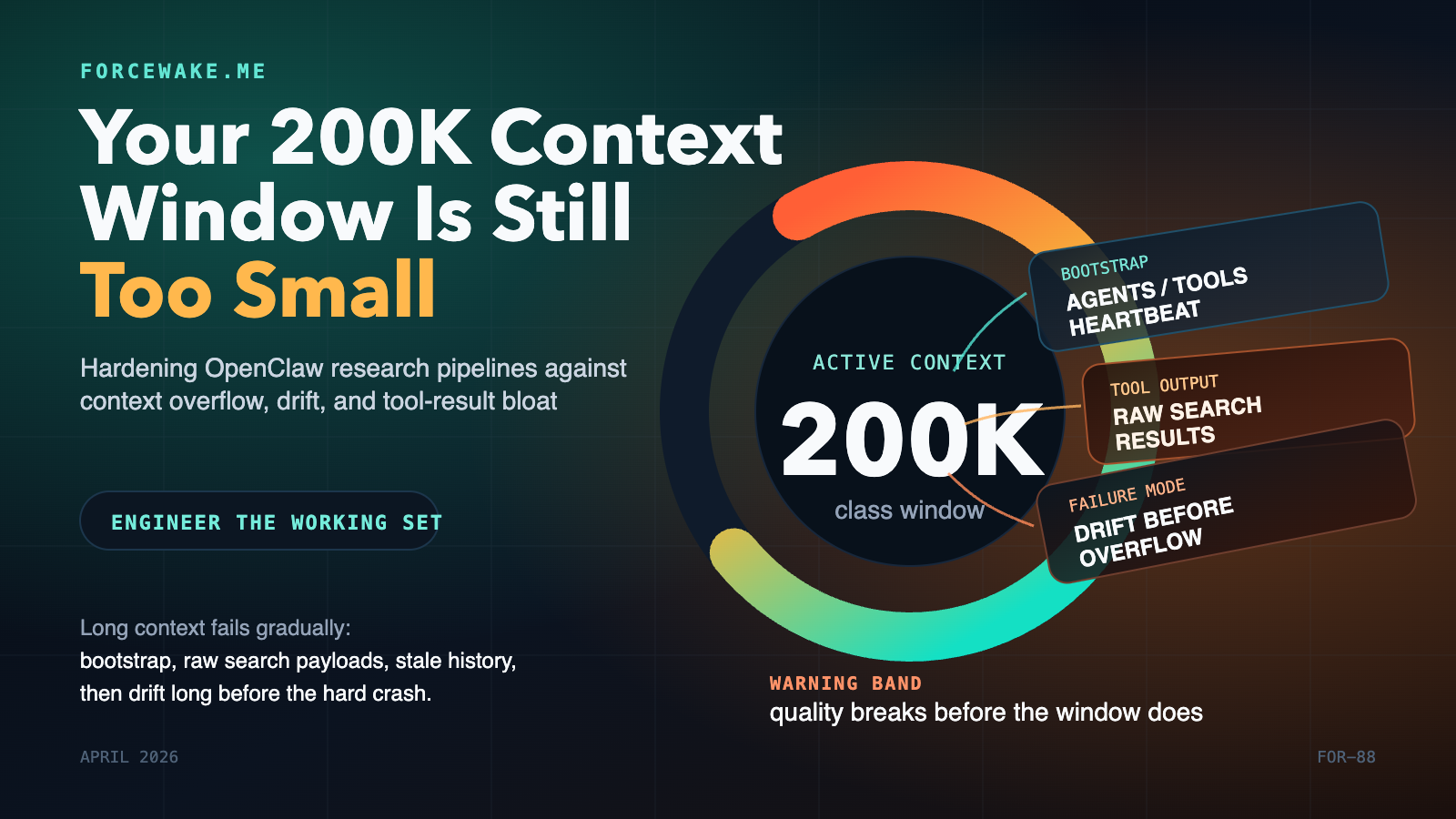
Your 200K Context Window Is Still Too Small: Hardening OpenClaw Research Pipelines Against Context Overflow

Most research-agent failures are not model failures. They are context-budget failures. You give the agent a large context window, then quietly burn it on bootstrap files, tool schemas, verbose search results, stale heartbeat history, and repeated prompt reinjection. The run still looks healthy for a while, but quality has already started to slide. The agent drifts, repeats searches, forgets what it just learned, or falls into overflow recovery loops. As of April 15, 2026, OpenClaw already exposes the right primitives to prevent that: detailed context introspection, isolated cron sessions, lightweight bootstrap context, session pruning, compaction, and heartbeat isolation. The engineering problem is not missing features. It is composing those features into a system that keeps the model’s active working set small, fresh, and task-specific. S1 S2 S3 S4 S5 ...

April 15, 2026 · 13 min · 2689 words · Pavel Nasovich

PlugMem Under the Hood: Why Knowledge-Centric Memory Changes LLM Agents

Most agent-memory systems still do the lazy thing: store raw interaction history, retrieve a few chunks, and hope the base model compresses the mess at inference time. PlugMem starts from a much stronger assumption. The useful part of experience is sparse, structured, and should be compiled before retrieval. That is why this paper matters. PlugMem was submitted to arXiv on February 6, 2026, published on the Microsoft Research site on March 6, 2026, and the PDF metadata marks it as an ICML 2026 proceedings paper. As of April 5, 2026, the code and benchmark artifacts are public. The claim is ambitious but concrete: a single task-agnostic memory module, attached unchanged to very different agents, can beat both raw-memory baselines and several task-specific memory systems while using much less agent-side context. S1 S2 S3 S4 ...

April 5, 2026 · 16 min · 3405 words · Pavel Nasovich